Officials Plan for 72 Hours. Here's What Your Family Should Plan For.
Months of careful preparation can unravel on day three without safe water. Here's the small fix that closes that gap before storm season peaks.

You're not the kind of person who leaves this to luck.
The pantry is stocked. The first aid kit is under the sink. There's a go-bag you keep meaning to finish, but it exists. You watched the Texas winter storm of 2021 put millions of people under boil-water notices in sub-zero cold, and you watched Fort Myers after Hurricane Ian — a week with no running water, families queueing for hours at distribution points, shelves cleared before the storm even made landfall.
And you made a promise: not us.
You've acted on it, too. Real steps most of your street hasn't taken.
So none of what follows is a knock on your prep. It's about the one gap that shows up in nearly every household kit — including kits assembled by people who clearly did their homework.
Kits everywhere have food and flashlights. Almost none can produce a gallon of safe water on day four.
Your Taps Only Work While the Grid Does
Clean water feels automatic right up until the second it isn't.
Your tap is the end of a machine — one of roughly 144,000 public water systems serving 330 million Americans, every one of them electric. Pumps, treatment trains, pressure zones — each stage needs constant power to push water through miles of pipe and keep it safe when it lands in your glass.
Lose the grid, and those facilities fall back to generators — the kind utilities budget to run for roughly a day, maybe two.
Once that fuel runs out, line pressure falls, and falling pressure can pull whatever surrounds the pipes inward. The treatment barrier disappears at exactly the moment the network is most exposed.
Every 2 minutes
a water main breaks somewhere in America — roughly 260,000 a year, leaking six billion gallons of treated water daily. The network behind your tap grades a C- from the country's civil engineers — on their A-to-F scale, that's mediocre and aging. It doesn't mean your water is dirty today. It means nothing stands between fine and do not drink except pressure in the pipes.
And nobody grades their own homework harshly.
Source: American Society of Civil Engineers, 2021 Infrastructure Report Card; Utah State University water main break study, 2023
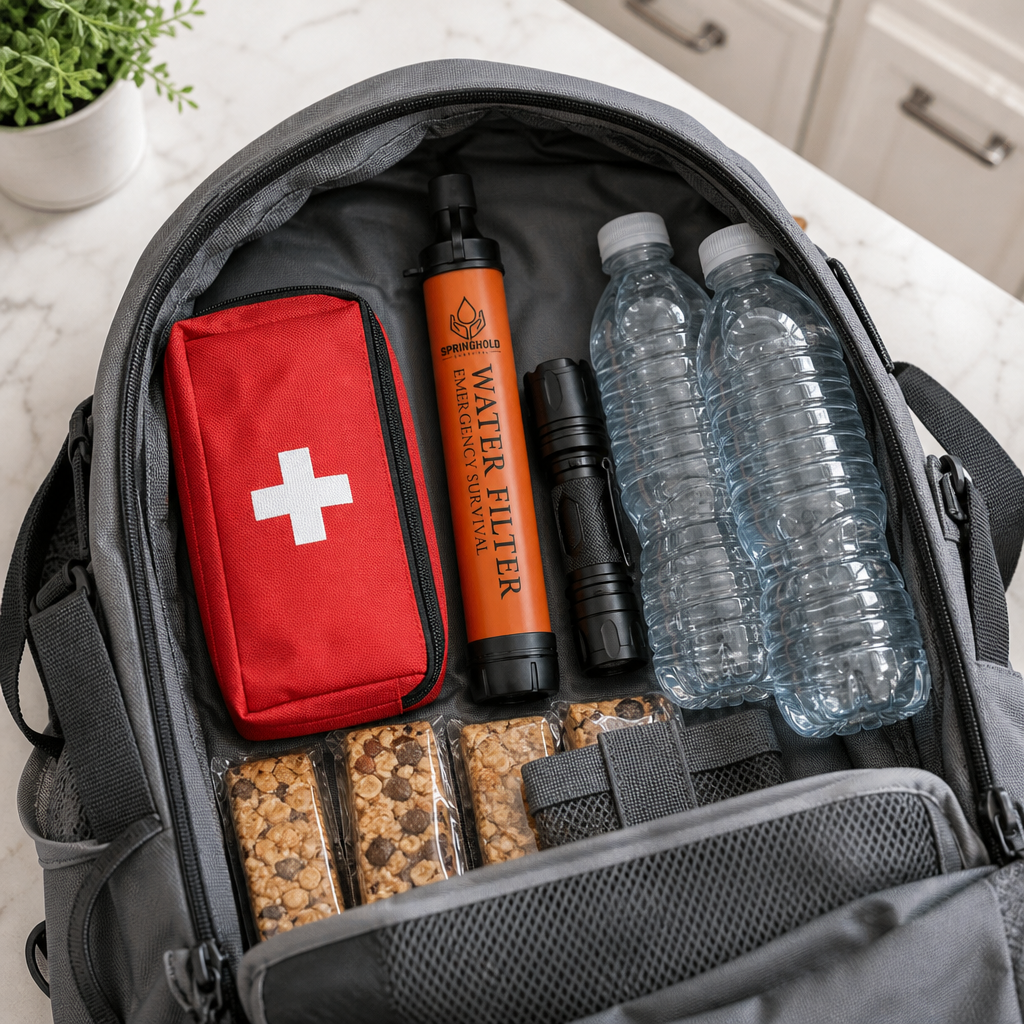
Jackson, Mississippi ran this experiment in real time. Flooding took out the treatment system in August 2022, and roughly 180,000 people went without dependable safe water — not for days, but for months.
Families boiled every drop they cooked with. Hospitals hauled in tankers. Nothing about Jackson's system was broken the week before — it simply couldn't take the hit.
Which is worth decoding: a boil-water notice means the water in your pipes, this morning, would make your family sick unless you treat it first.
4,000+ in a single year
boil-water advisories documented by the EPA — eight in ten caused by broken mains, repairs, and lost pressure. Not hurricanes. Broken pipes. And no one is required to report the rest.
Source: U.S. EPA, Report to Congress: National Occurrence and Causes of Boil Water Advisories, May 2024
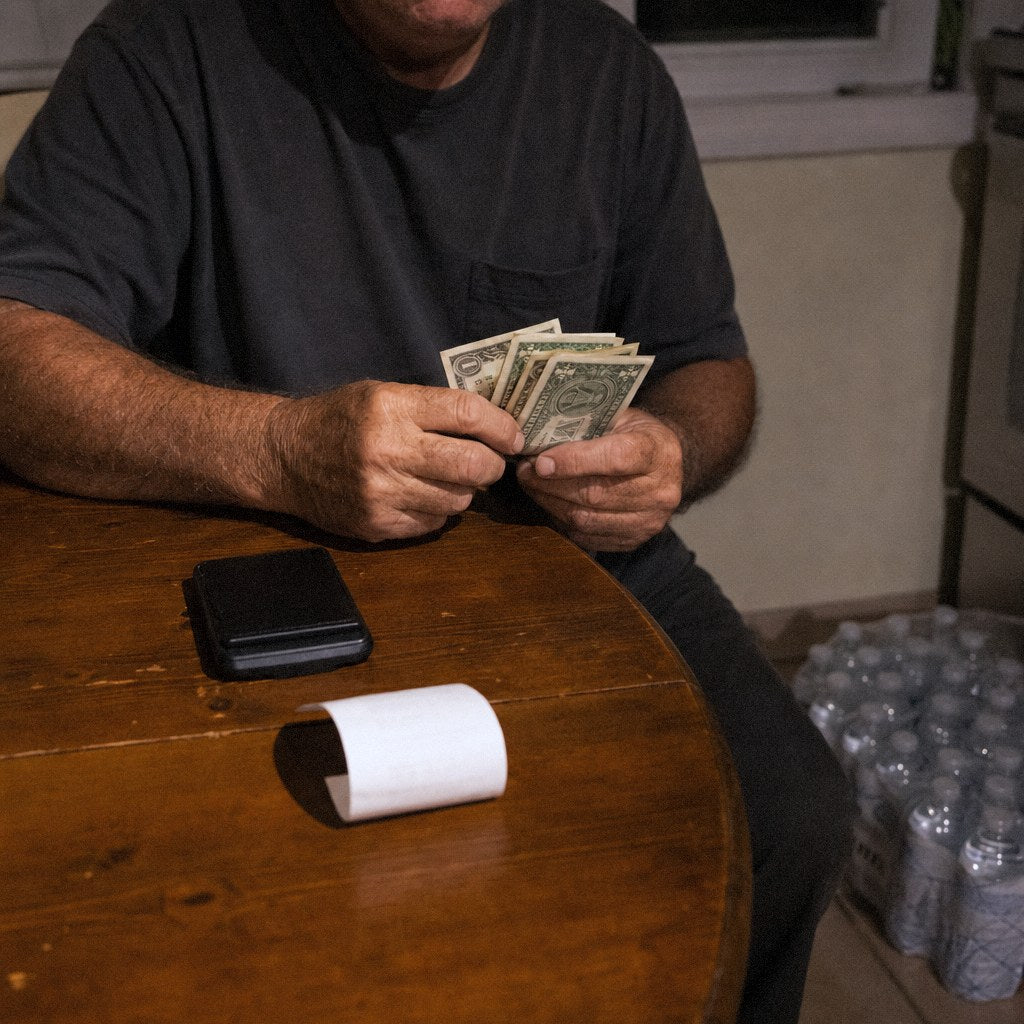
Figure one gallon per person per day, minimum. For a household of four, a down grid means finding 28 gallons a week.
The Case-of-Bottles Backup Plan Fails Fast
Tally up what most households actually have on hand.
A couple of cases out in the garage. A gallon or two in the kitchen. If you're ahead of the curve, a 5-gallon jug that gets topped off now and then.
Here's the catch: four people drain that cache in two to three days. Heat speeds it up. Sickness speeds it up. Cooking, pet bowls, and basic hygiene finish the job.
The human body runs on a three-day clock without drinking water. The official 72-hour plan covers exactly that — no margin, no overtime.

When Ian came ashore in Southwest Florida, relief sites were running out of water within hours, and stores a full county away sold out before the storm had even finished arriving. Inside the impact zone, driving wasn't an option anyway — flooded roads, dead traffic lights, closed fuel stations.
The households that stayed supplied for a week weren't the ones with the tallest stack of cases. They were the ones who could treat whatever they could reach — rain barrels, puddles, a creek, the pool down the street.
And this isn't only an American problem. Every country that treats water as a utility assumes the utility will always win — until a storm, a flood, or a burst main says otherwise. The maps change; the 72-hour clock doesn't.
Against that math, the fix itself is the smallest line item in the plan: $29.95, once — not per week, not per person. One filter in the kit treats up to 1,800 gallons, and it never asks for another dollar.
66% OFF — LAUNCH PRICING

SpringHold Survival Straw — Advanced Water Filter
Launch pricing — 66% off while stock lasts
PREPARE NOWFive Gaps Most Families Never See Coming
Shelves clear in hours, not days.
Announce a water advisory and the bottled aisle is gone the same day. First arrivals take the stock; everyone after them photographs empty shelves.
East Palestine, Ohio made the point in February 2023. One industrial accident — no hurricane, no grid collapse — and stores across a 30-mile radius were out of bottled water the same afternoon. People were crossing county lines for a trunkload of cases.
Once the event starts, the supply chain is no longer available to you.
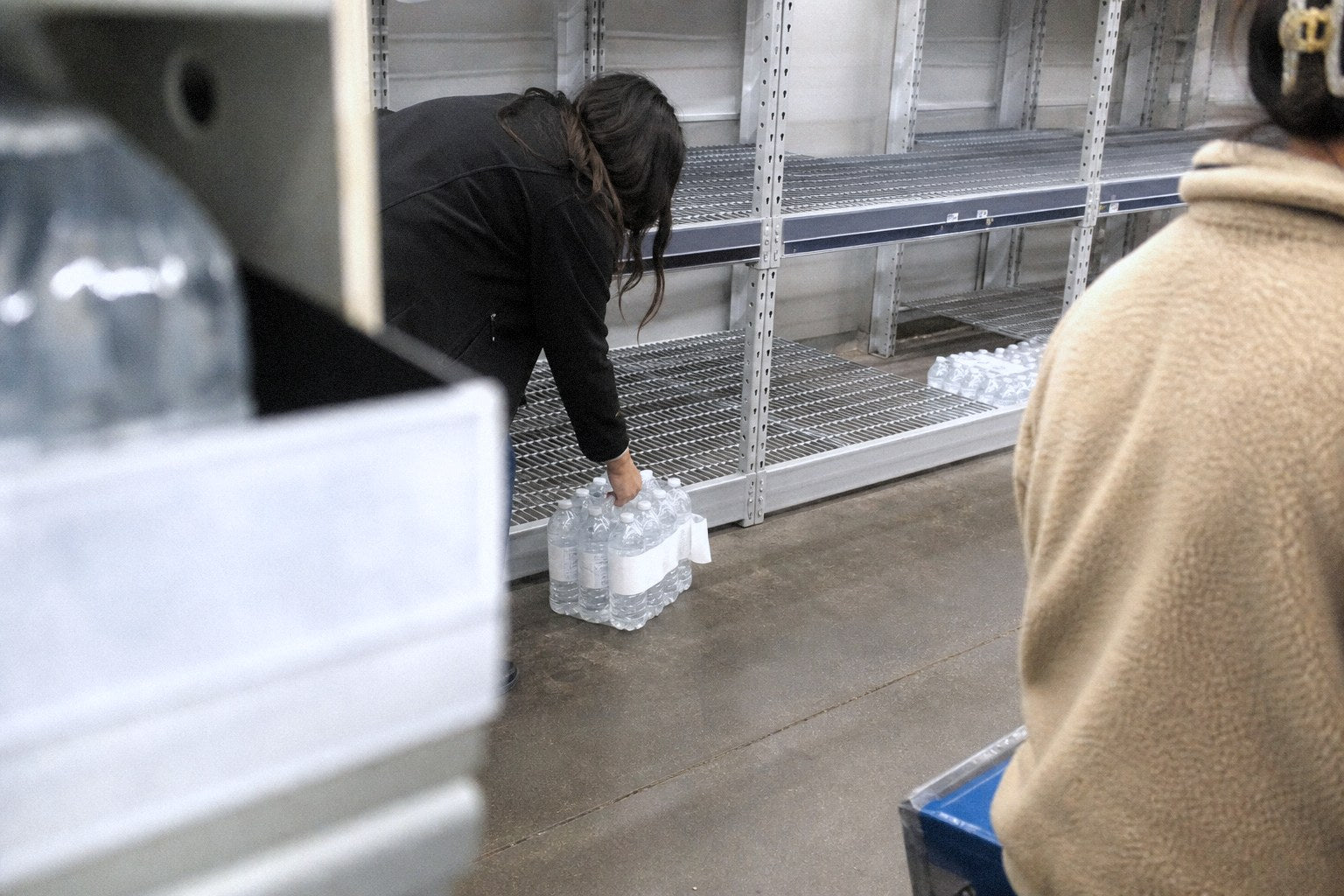
Bad tap water is more dangerous than no tap water.
Dirty water isn't the same problem as missing water. It's the nastier one.
In the Texas freeze, breaks across the network dragged soil contamination into the pipes. Hundreds of systems issued boil notices — to households sitting in the dark with no way to boil anything, some unaware their problem was chemical, which no amount of boiling fixes.
East Palestine added the second lesson: vinyl chloride in the water table meant boiling didn't purify — it concentrated whatever was already in the pot.
A basic membrane filter handles bacteria and protozoa. Fuel compounds, chemical runoff, and agricultural contamination are a different animal — those need an activated carbon stage most portable straws skip entirely.
That's not a job the average pocket filter was ever built for.
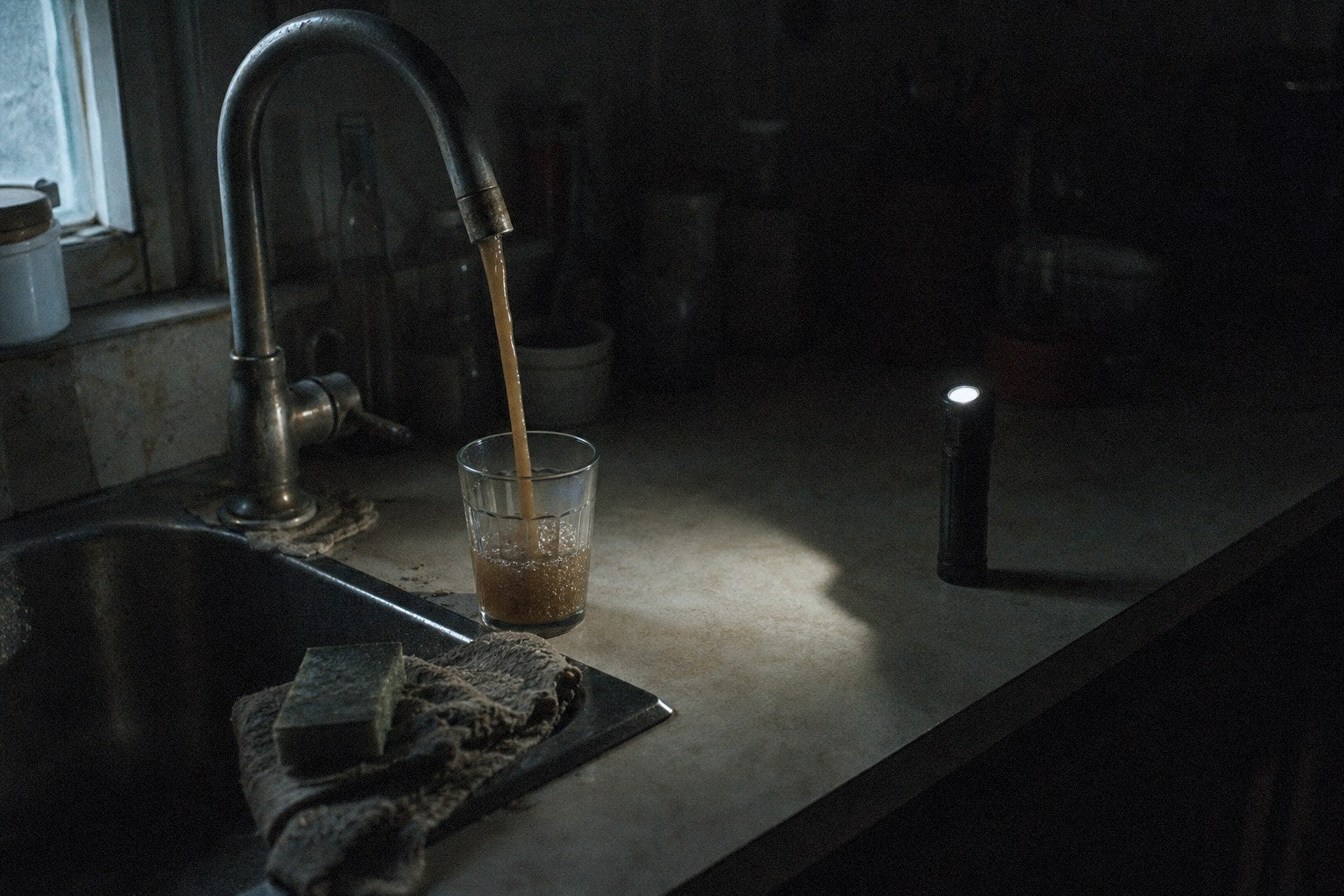
The official plan covers 72 hours. That's the floor, not the forecast.
Read Ready.gov or any county emergency plan and you'll find one number repeated: 72 hours of self-reliance. That's the window officials ask you to cover before meaningful help shows up.
Reality, after Ian and Katrina and through the Jackson crisis, ran longer: five days to two weeks before help reliably reached households. Not apathy — arithmetic. The infrastructure damage outran the convoys.
No end date in sight
nearly three in ten of the boil-water advisories the EPA tracked in 2021 were still open — or had no documented end date at all — when the year closed out. Advisories don't always run 72 hours. Sometimes they don't end.
SpringHold is built for the long version: up to 1,800 gallons from a single straw. No power, no resupply runs, no bottles to ration.
Source: U.S. EPA, Report to Congress: National Occurrence and Causes of Boil Water Advisories, May 2024
Cover the three days because you're told to. Cover the two weeks because history says so.
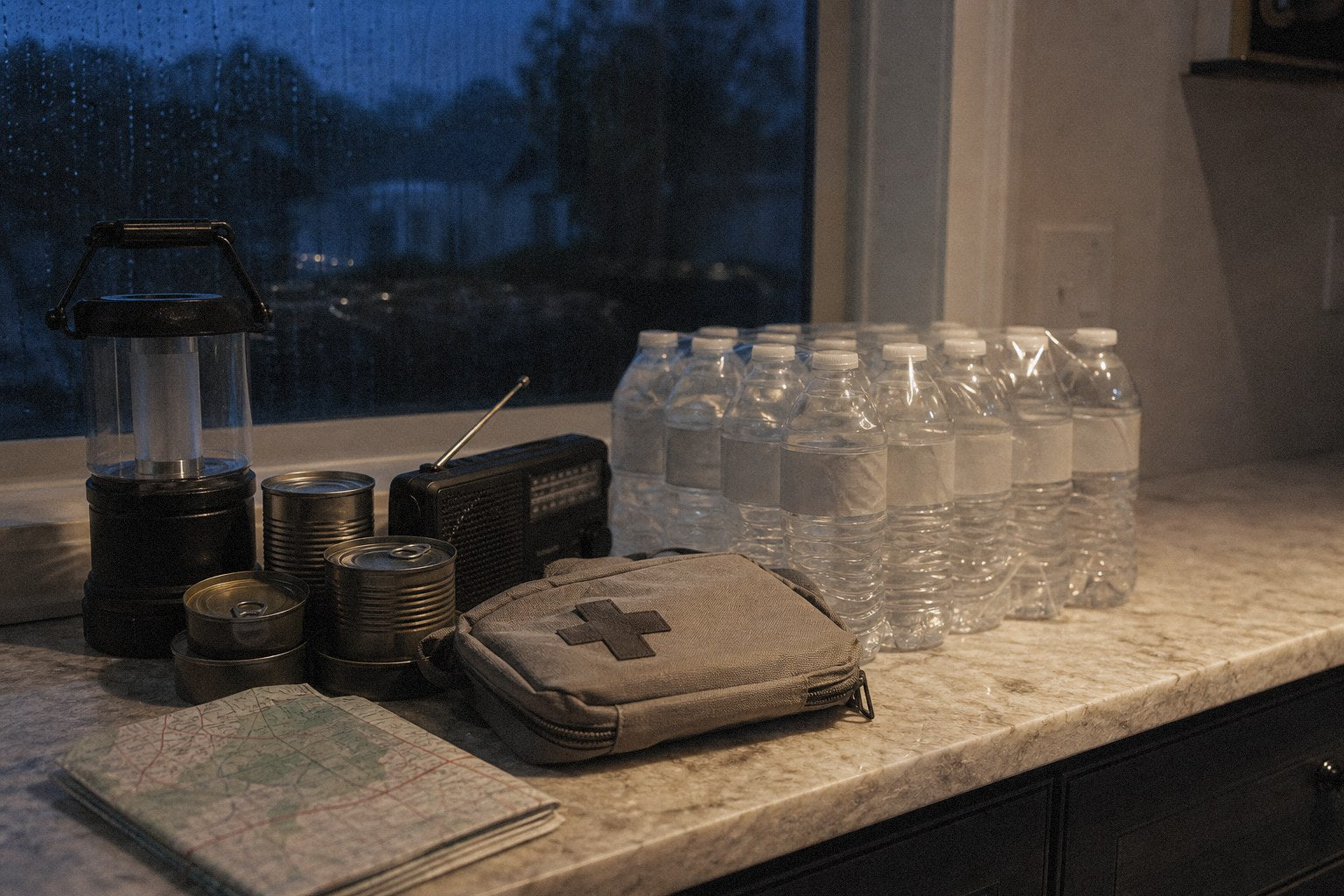
The camping filter in your drawer wasn't built for this.
The best-selling filter straws were engineered around one scene: a hiker kneeling at a clear mountain creek.
At 0.2 microns they catch bacteria and protozoa reliably. Viruses, twenty to thirty times smaller, pass straight through. There's no carbon stage, so chemicals and foul tastes go untouched. And the format is face-down-at-the-creek: no filling a bottle, no carrying clean water with you.
Compact squeeze models add a similar pore size and a well-documented habit of clogging under sustained use.
For a thru-hiker, those are the right tools. For a family in week two of a boil notice, they're the wrong shape of solution.


The math on doing nothing is brutal.
A proper family filter costs about what you'd spend on one dinner out. Doing nothing bills you later: gouged bottled water by the case, an ER visit from contaminated water, an evacuation you couldn't provision for — thousands, easily.
Through the Ian response, relief groups kept repeating the same finding: at site after site, water requests outran food — for days on end.
One small filter in the glovebox retires that entire bill.
Built for Exactly This Scenario
SpringHold was designed around a single brief: safe water from whatever source a family can reach — no setup, no power, no learning curve.
Where it splits from the camping-aisle options:
0.01 micron UF membrane.
Twenty times finer than the 0.2-micron camping standard, it strains out bacteria, protozoa, and debris at a level pocket filters rarely reach.
Activated carbon fiber layer.
Membranes alone only fight biology. The built-in activated-carbon fiber stage takes on chlorine, chemical tastes and odors, and many common contaminants — precisely what a compromised city supply produces.
Bottle-threading design.
The format change that matters day to day: instead of crouching face-down at the source, you thread the straw onto any standard bottle cap — a Nalgene, a soda bottle, whatever container is on hand — and filter water on your feet. Fill a bottle, pass it to your kid, stash clean water for later. The water source stops being a place you're stuck at.
No batteries. No power. No upkeep.
No batteries, no power, no upkeep — suction is the entire engine. A child can work it in half a minute, and it performs the same a decade from now.
1,800-gallon filter lifespan.
Rated to 1,800 gallons, one unit covers a family of four's drinking water for more than a year. That's infrastructure, not a gadget.
No expiry date.
Glovebox, kit bin, hiking pack — sealed storage means it's ready the day you finally need it.
BPA-free.

Four Places to Keep Yours
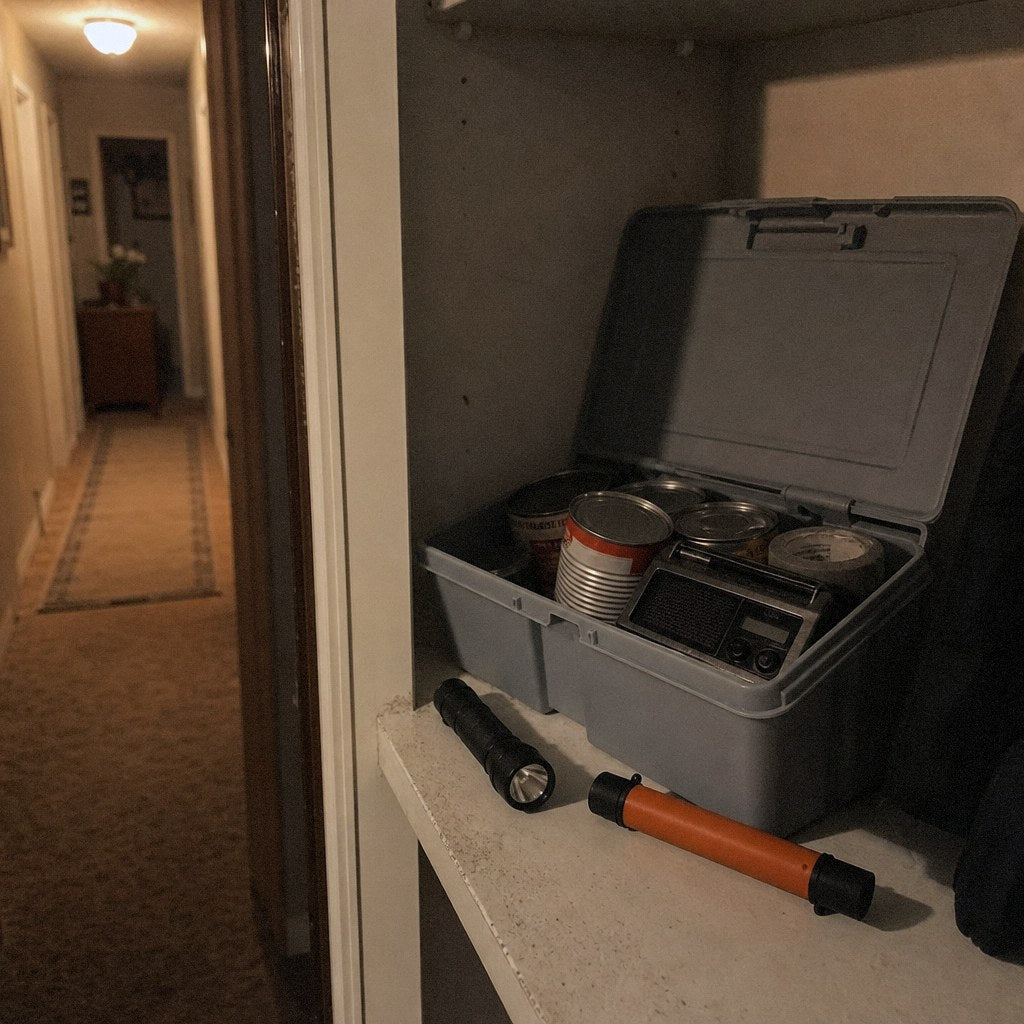
The home kit
The kitchen emergency bin or the storage tub — the first place everyone looks when the lights go out. One straw turns the water you already have on hand into drinking water, no boiling required.
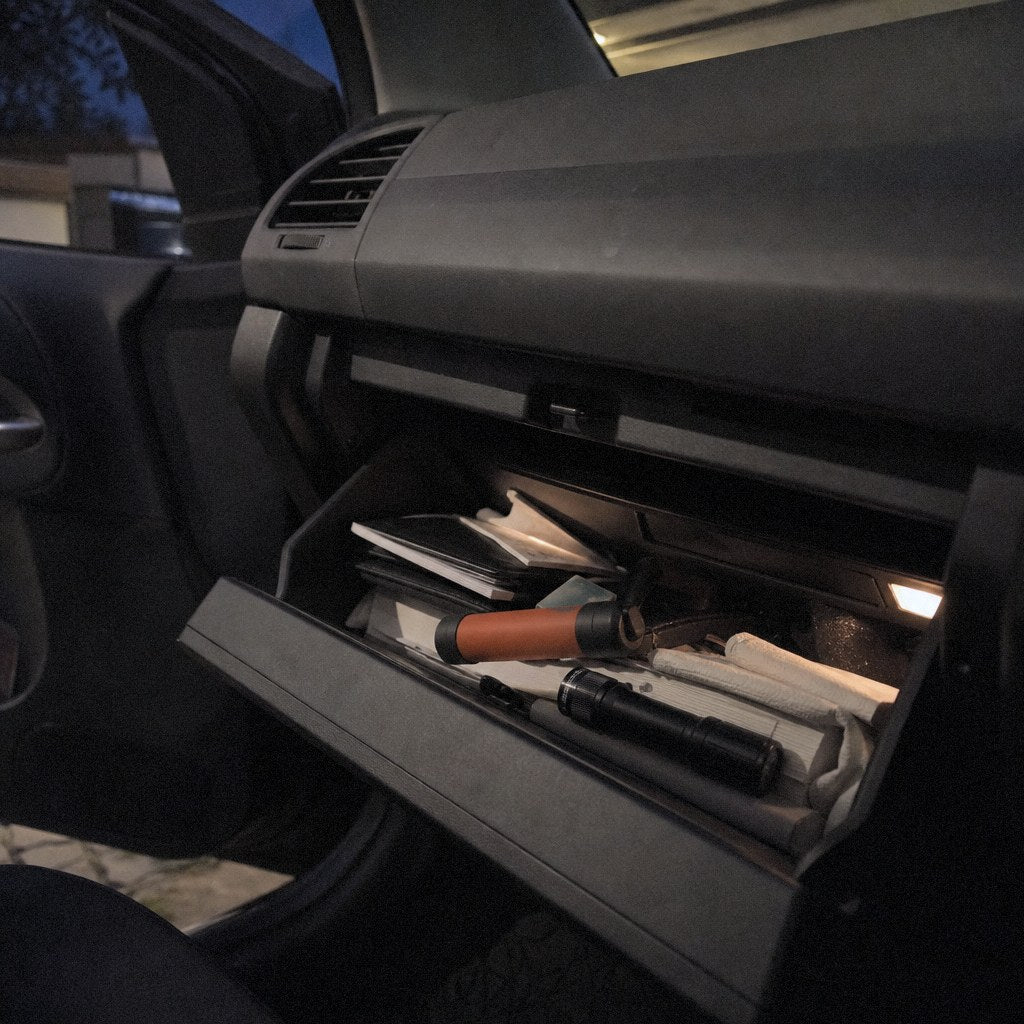
Every car
A case of bottled water lives in the trunk and runs out; this lives in the glovebox and filters from any bottle you find along the way.
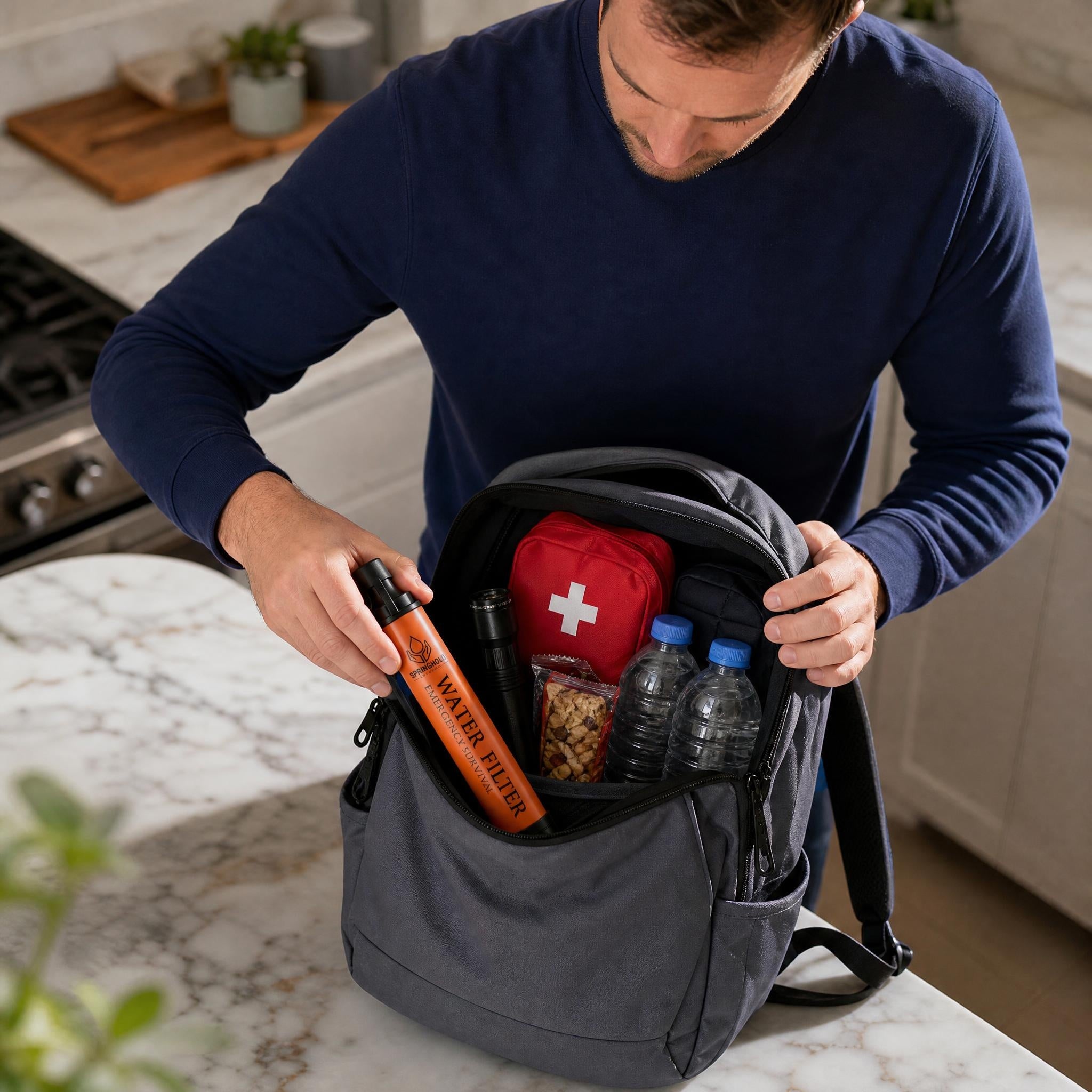
Go-bags
School bags, hiking packs, the duffel by the door. Two ounces takes up no space and turns any bag into a water plan.
Parents' homes
No batteries, no instructions, no squeezing technique. Simple enough that every generation can use it without a walkthrough.
Before You Ask
How does it work?
Inside the housing, two filters work in line. First, a 0.01-micron hollow-fiber membrane acts as a sieve: bacteria, protozoa, and grit are simply too large to fit through pores that size. Behind it, an activated-carbon fiber stage catches chlorine and the organic compounds responsible for chemical tastes and smells. You provide the suction; the straw handles everything else.
What does it filter out?
Pathogenic bacteria (E. coli, salmonella, cholera) are reduced by 99.9999% and protozoa like Giardia and Cryptosporidium by 99.9%, alongside sediment, microplastics, and the chlorine and organic chemicals that make water smell and taste unpleasant. It is not designed for viruses or dissolved heavy metals. In the scenarios this straw exists for — boil notices, flood runoff, backcountry water — bacteria and protozoa are the threats that matter most.
Why not just boil water?
Boiling is reliable when your kitchen still works. Emergencies rarely cooperate: fuel runs short, the power is out, and ten minutes over a flame does nothing about chemical contamination anyway. A SpringHold straw has none of those dependencies — no heat, no fuel, no wait. Fill your cup and drink. Boil when you can; use the straw when you can't.
How long does it last?
Up to 1,800 gallons from a single straw — roughly 6,800 liters. Nothing inside it expires or wears out on a calendar: stored dry and capped, it performs just as well a decade from now. At emergency ration levels (about two liters a day), one straw outlasts most crises many times over.

Your Family Pack — Ready to Ship Today
Most households lock in their water plan at the top of storm season, and our warehouse feels it every year around now. If the button below is live, stock is on hand today.
Water your family can count on — whatever the forecast says.
5-Pack SpringHold Survival Straw — $84.95
One kit covers everyone in the house through a disruption:
- 5× SpringHold Survival Straw filters (0.01 micron, 1,800 gallon lifespan each)
- Free shipping
- 365-day money-back guarantee
Total value: $249.95. You pay $84.95.
Get My 5-Pack — $84.95 + Free Shipping
The Guarantee
A full year. Try it, stress it, change your mind.
Use it for six months, toss it in the kit, and if it isn't right for your family, one message to support gets you a full refund — no forms, no interrogation. We built this for our own households and stand behind it on that basis.
One More Thing
You already believe the risk — you've watched it land on other towns, other households, people who also assumed they were ready.
The distance between their story and yours comes down to one unremarkable decision, made early, while everything is still calm.
When the water question arrives, let the answer already be in your kit.
